The Invisible Seam: How Room Tone Archivists Keep TV Edits From Showing
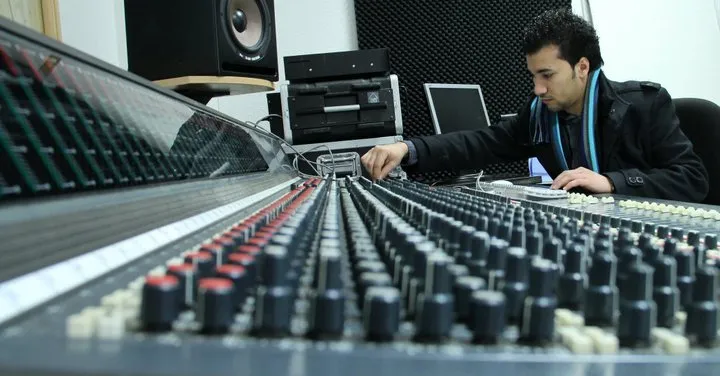
Photo: Ahmed Maalaoui, CC BY-SA 3.0, via Wikimedia Commons
Room tone is the sound of a space with no one in it. Not silence—silence is a digital zero. Room tone is the hum of a stage, the breath of an HVAC system, the faint street noise bleeding through a wall. It’s the ambient bed that dialogue sits on, and without it, every cut becomes a tiny cliff. In 2026, as streaming shows pack more music, effects, and dialogue into every frame, that bed of almost-nothing has become one of TV’s most valuable—and least visible—assets.
The Sound of an Empty Room
On a soundstage, the room tone capture often happens after the cast and crew have cleared out. A production sound mixer or a dedicated utility recordist will ask for a minute of quiet—no footsteps, no whispers, no air conditioning cycling on—and roll a few takes of the space just breathing. It’s not glamorous work, and it rarely makes the call sheet in bold. But those sixty seconds are the raw material for every seamless cut that follows.
The goal isn’t to capture nothing. It’s to capture the specific something of that room: the low-frequency rumble of a distant highway, the shimmer of a fluorescent light, the way a wooden stage floor reflects a voice. That specificity matters because dialogue recorded on set is never perfectly consistent. An actor turns their head, a boom operator adjusts, and the background noise shifts. Room tone gives editors a neutral patch to splice under those shifts—a sonic bandage that keeps the scene from sounding stitched together.
From Set to Server
Once recorded, room tone enters a chain that most viewers never think about. It gets labeled, logged, and stored—ideally alongside the episode, the set, the microphone, and the time of day. In 2026, more post houses are treating room tone like any other metadata asset, tagging files so that a mixer working months later can search for the right texture without scrubbing through hours of wild sound.
That cataloging is harder than it sounds. A show that shoots across multiple locations might have dozens of distinct room tones: the apartment set, the precinct set, the exterior alley, the van. Each one has its own fingerprint. A good archivist knows that the room tone from a Tuesday morning scene won’t necessarily match a Friday night scene if the building’s HVAC was running on a different schedule. The work is part librarianship, part listening, and part memory.
Why Loud TV Needs Quiet Archives
Streaming has made television soundtracks busier. Music cues arrive earlier and sit louder. Sound effects are more layered. Dialogue is often pushed forward in the mix, which means any inconsistency in the background bed becomes more noticeable, not less. When a show cuts between two angles and the room tone jumps even slightly, the audience may not be able to name what’s wrong, but they feel it. The edit stops being invisible.
That’s where the archive earns its keep. Room tone is used to smooth those transitions, to fill the gaps under ADR lines, and to mask the seams between locations. It’s also a continuity tool across seasons. A show that returns after a two-year hiatus may find itself shooting on a different stage with a different hum. If the original room tone was preserved, the mixers can blend the new recordings with the old, keeping the show’s sonic fingerprint intact even when the physical space has changed.
In 2026, the demand for that continuity has grown. International co-productions, remote post workflows, and the sheer volume of streaming content mean that the person mixing episode eight may never have set foot on the stage where episode one was shot. The room tone file becomes a kind of handoff—a quiet note from the production to the post team that says: this is what the space sounded like.
Losing the Fingerprint
What happens when a show loses its sonic fingerprint? It can happen quietly. A hard drive fails. A post house closes. A production moves from one vendor to another and the room tone folder doesn’t make the trip. Or a location shoot wraps without anyone remembering to record the space before the crew struck the set. In those cases, mixers borrow from another scene or another show, and the result isn’t a mistake you can hear, exactly. It’s a mistake you can feel—a scene that sounds slightly too clean, or slightly too hollow, or like it’s happening in a room that doesn’t exist.
The loss is rarely dramatic. No one gets fired over a missing room tone file. But the show’s texture changes. The cuts become a little more visible. The dialogue sits a little less naturally. And the audience, without knowing why, might describe the episode as feeling off.
The Human Ear at the End
Despite the metadata and the software, room tone is still a craft of listening. The best archivists and mixers can tell the difference between a room recorded in the morning and the same room recorded after lunch. They know that a stage sounds different when it’s empty versus when it’s full of lighting equipment. They know that a hotel hallway at 2 a.m. has a different silence than the same hallway at 2 p.m.
That knowledge doesn’t show up in the credits. It doesn’t win awards. But it’s the reason a cut can disappear, the reason a scene can feel like it was captured in one breath instead of assembled from a dozen takes. Room tone is the quietest department in television—and one of the few that works best when no one notices it at all.